An Interview Guide for Endings

Image by David Kesser, www.davidkessler.biz/art_gallery.htm

I just taught a course in the American University MSOD program called Implementing System Change.  It is the last course of a two-year program.  On the last day, I wanted to give the students some time to dive deeply into a reflection about their experience of the whole program.

My friend and colleague, Sue Woehrlin, who teaches at Antioch University Seattle, suggested using the Hero’s Journey as a framework. What a terrific idea!  I drafted questions using an adaptation of Joseph Campbell’s stages of the journey.

The interview guide got it’s inaugural run this weekend.  The students loved it!  And the quality of the group discussion told me that they had gone deep with each other.  I think it did its work to 1) help them prepare for their comp exam; and 2) support them in integrating their experience.

The guide is intended to be used in trios, with an interviewer, interviewee, and a note taker.  I had envisioned 1.5 hours — 30 minutes a person.  We ended up with about 20 minutes a person, which was a little skinny.

Rather than giving them the discussion guide — also in the attachment — to use in groups of 6, we moved from trios to the whole group.  So I used the discussion guide to shape prompting questions for the whole group discussion.

I’m sharing the interview guide because it could be adapted for the closure of any immersion experience.  Enjoy!

Share
Posted in Emergence | Comments Off

The Future of Western Civilization

Now isn’t the future of our civilization a big topic!  I did an interview on February 29th with Nicholas Beecroft.  He’s been pursuing this subject by talking to a variety of people.

The questions Nicholas asked were so big that I found myself looking for simple, practical answers.

Check out my responses to:

  • How can we boost our cultural direction and self-confidence?
  • What’s your highest vision for Western Civilisation?
  • What’s the new, emerging civilisation?
  • Whats great about the current Western Civilisation which we should preserve and cherish?
  • How can we ignite a self-propagating group process to transform Western Civilisation for the better?
  • How can we evolve democracy to be deeper and more effective?
  • How can we integrate the dark, shadow side of our history so as to unlock our power and potential? Do we or anyone need to have a strategy in the traditional sense?
  • How do we best support collective intelligence, group change processes and emergence to get the best outcome?
  • How can we reorganise our large government bureaucracies for health, education, welfare etc to fully liberate the human spirit of the staff and community and to embed a learning, evolutionary system to harness global intelligence?
  • How do we create new fields of consciousness – our energetic potential into which the future will emerge- create the field of alignment and remove the obstacles and provide the support structures and allow the self-organisation to occur?

If you prefer, here’s an MP3 for download

To see a list of Nicholas’ other interviews, take a look:

Share
Posted in Emergence, Leadership, Video | Comments Off

On Gratitude: With a nod to Harrison Owen, Anne Stadler, and Spirited Work

When I ran a session last year at the International Conference on Complex Systems, I was struck by a practice followed by most of the presenters.  They acknowledged the people who had influenced their work.

I’m just finishing a wonderful book that I got at the conference: Complexity: A Guided Tour by Melanie Mitchell.  It’s a terrific overview, looking across multiple disciplines – computation, evolution, genetics, networks and more. Like the conference presenters, Mitchell included photos of thought leaders as she introduced their ideas.

I am inspired by this custom of honoring those who influence you!

So as I return to my blog after a crazy, wonderful, hectic year of sharing the ideas from the award-winning Engaging Emergence: Turning Upheaval into Opportunity, I thought I’d begin with a thanks to those who have most influenced my work:


Spirited Work was an Open Space learning community of practice that met quarterly from 1998 to 2004 to explore the intersection of being and doing – spirit and work.  Anne Stadler cooked up the idea of Spirited Work.  It became our playground for learning about emergence in human systems, among many lessons.  It continues to inform our work and our friendship years later.

The form at the heart Spirited Work – Open Space Technology – was created by Harrison Owen.  Harrison introduced me to Anne – one of the many gifts for which I am grateful.  Beyond the intro to Anne and Open Space Technology, Harrison’s friendship has brought with it his lifetime of learning about chaos and order.  My first taste came during an Open Space Technology workshop that I did with Harrison in 1999. As participants were off in breakout sessions, Harrison told me of his Ph.D. research into chaos and order.  He spoke of the contradictory images of an immanent and a transcendent G-d in the Old Testament.  I remember the question said he was researching: if the best and the brightest of the time created this holy book, what was their purpose in introducing so much contradiction?

His stories about pursing that question, not to mention the power of the question itself, influenced me more than I can put into words.  Through the years of making sense of why Open Space works, that use of the language of spirit coupled with an explanation based in complexity science helped me to recognize that these were simply two ways of pointing into the same territory.

When I talk about the gifts I’ve received from knowing Harrison and from Open Space, I often share some lessons that I took away early on:

  • Generosity of spirit.  Harrison opted not to copyright or trademark the process.  Instead, he made it clear that Open Space is free for the taking. The only responsibility is to give back, to share what you learn.
  • Focus on essence. While it is easy to get wrapped up in the complexity of any situation, Harrison has a talent for attending to what matters most. All the rest is details.
  • Simplicity of design.  I’ve called Harrison a master of laziness, always finding the path of the least effort for the greatest outcome. I love the power of a question he always poses: What’s one less thing to do?  To which I add: and still be whole and complete?
  • Inclusion/invitation. The stories Harrison tells of welcoming the stranger makes it exquisitely clear that both the stranger within and from outside bring gifts, no matter how they how they show up.

So I open this year on my blog with gratitude to Spirited Work, Anne Stadler, and Harrison Owen!

Share
Posted in Open Space Technology | Comments Off

An interview with WGRN radio

While I haven’t taken the time to write about the Occupy movement as a great example of people engaging emergence, I have been invited to do a couple interviews on the subject.

Here’s the first,with Jerry Ashton of 15 Minutes of Fact:

Voices of Occupy Wall Street: An Author and Consultant’s View Of the #Occupy Movement – Peggy Holman

Share
Posted in Engaging Emergence, Leadership | Tagged , , , | Comments Off

Liz Rykert Reflects on Engaging Emergence

Liz Rykert, President of Meta Strategies, interviewed me on a “Plexus Call” – an unrehearsed, spontaneous conversation among leading complexity scholars and practitioners — for the Plexus Institute.  Liz shared her notes with me and I share them with you!

My Preparation for the Interview with Peggy Holman and her new  book Engaging Emergence for the Plexus Institue’s Plexus Call on February 11th, 2011.

As I read the book I felt a sense of circling back and opening up and circling back and opening up. I found myself drawing a visual guide to map out the ideas in the book, helping me to both attend to the sections and the whole at the same time. For me this is not unlike what you need to think about when engaging emergence itself. Of particular note I appreciated the section devoted to the “catches” one encounters while engaging emergence. These rang true for me especially in my positive deviance work. As I went through the book I noted the sequence of questions she shared and extracted those for myself to use them as a stand alone guide to assist in the work. I include them below along with my doodles.

The conversation with Peggy was a delight, full of insight and discovery.

Liz Rykert – Feb 14/11

The Sequence of Questions in Engaging Emergence

  • How can we use our differences and commonalities to make a difference?
  • What is the difference that makes a difference?
  • How do we more fully understand each other and our environment?
  • How do we link ourselves and our ideas with others similar and different than ourselves?
  • What does it take to be receptive to the unknown?
  • Call forth what could be: What do we want more of?
  • What is working?
  • What is possible?
  • How do we create it?
  • What guides us when we don’t know?
  • What purpose moves us?
  • How do we cultivate conditions for the best possible outcomes?
  • How do we include the true diversity of the situation?
  • How do we engage so we achieve the best possible outcomes?
  • How do we inspire explorations that lead to positive actions?
  • What could we do together that none of us could do alone?
  • What would it look like if we were working?
  • What could this team also be?
  • How do we release assumptions of how things are to make space for new possibilities?
  • What is arising now?
  • What themes are surfacing that excite us?
  • What can we name now that wasn’t possible before?
  • How do we call forth what is ripening?
  • Once meaning is named how is it spread?
  • What keeps us going?
  • How do we find potential in the midst of disruption?
  • How do we create conditions in which chance interactions among diverse members of a system lead to break throughs?
  • How do we surface what matters to the individuals and to the whole?
  • How do we make space for the whole story – god, bad, or indifferent?
  • What is the least we need to do to create the most benefit?
  • What is our purpose in seeking change?
  • What is one less thing to do and still be whole and complete?
  • How do we disrupt coherence compassionately?
  • How do we engage disruptions creatively?
  • How do we renew coherence wisely?
  • How do we find potential in the midst of disruption?
Share
Posted in Engaging Emergence | Tagged , | Comments Off

Journalism that Matters video makes the home page of the Knight Foundation

Beyond Bookstook place at MIT in Cambridge, Mass. on April 6 and 7, 2011.  The organizing question:

What’s possible when journalists and librarians come together?

We brought together about 130 participants to explore this question.  Filmaker, Jacob Caggiano, created a fabulous 7 minute video that tells the story.  And it was so good, that the Knight Foundation put it on their homepage!

Check it out:

Beyond Books – What’s possible when librarians and journalists meet? from Jacob Caggiano on Vimeo.

Share
Posted in Emergence | Tagged , , | Comments Off

2011 Nautilus Book Award Gold Medal Winner

I recently got the news that Engaging Emergence: Turning Upheaval into Opportunity won the gold Nautilus Book Award for Conscious Business/Leadership.

From their site:

The Nautilus Awards recognize books that promote spiritual growth, conscious living & positive social change,  while at the same time they stimulate the ‘imagination’ and offer the reader ‘new possibilities’ for a better life and a better world.”

They look for distinguished literary and heartfelt contributions to spiritual growth, conscious living, high-level wellness, green values, responsible leadership and positive social change.

Previous winners include Deepak Chopra, His Holiness the Dalai Lama, Riane Eisler, Thich Nhat Hanh, Jean Houston, David Korten, Frances Moore Lappe’, Eckhart Tolle, Lynne Twist, Andrew Weil.

Nice company!

Share
Posted in Announcement, Engaging Emergence | Tagged , | Comments Off

See Possibilities — Turn upheaval into opportunity

So many ways to express a few ideas!

I recently published an article in Personal Excellence, a journal that reaches over half a million people.  Here’s the text:

WHAT IF YOU KNEW HOW to face challenging situations with a high likelihood of achieving breakthrough outcomes?

Image by David Kesser, www.davidkessler.biz/art_gallery.htm

Your success becomes more likely when you clarify a vision that energizes you and helps you turn difficult, conflicted issues into transformative leaps of commitment and achievement.  By doing so, you engage the natural forces of emergent change.

All change begins with disturbance. Without disruption, there’d be no need to change. By developing a healthy relationship with disturbance, you turn resistance and denial into curiosity and creativity. Since disruption brings out strong emotions, being compassionate helps. At root, compassion means to suffer with. Compassion reminds us that we’re all in it together.

One way to engage disruption compassionately is asking possibility-oriented questions. Consider asking: Given this loss or change, what’s possible now? Asking such questions helps you generate welcoming conditions for creativity.

Engaging creatively with disruption helps you discover differences that make a difference. To maximize your creativity, generate innovative ideas, and establish new relationships, take responsibility for what you love as an act of service. This game-changing way of working liberates your heart, mind, and spirit. It calls you to pay attention to what matters most, drawing out your unique gifts and talents. Spread your wings and step up to your leadership potential.

Create welcoming conditions that provide the space to explore different perspectives. You will spark innovation, solidarity, generosity, and unexpected answers.  You will discover shared meaning or purpose that unites individual needs with those of the organization, turning us- and-them divides into a spirit of we. This shift is counter-intuitive!

If you believe that to belong, you must conform, you will sacrifice to make compromises that no one likes.  The result: feeling dissatisfied and isolated. Instead, collectively reflect, inviting unique expressions of what matters to you and to others. It generates breakthroughs containing what is vital to each and all of us.

When you face challenges, compassionately disrupt by asking possibility-oriented questions like How can we use our unique gifts to create great results? Creatively engage diverse people by inviting everyone to take responsibility for what they love as an act of service. You’ll discover differences that make a difference. Finally, wisely renew yourself and your organization by reflecting with others and acting on what matters. You will turn upheaval into opportunity.

Peggy Holman helps you create a desirable future. She is author of Engaging Emergence and coauthor of The Change Handbook (Berrett-Koehler).

Share
Posted in Engaging Emergence, Leadership | Tagged , , , , | Comments Off

Recent Talks

I’ve done two interviews recently on Engaging Emergence: Turning Upheaval into Opportunity.

Someday I’ll get used to the sound of my own voice!

Image by David Kessler, www.davidkessler.biz

Share
Posted in Emergence | Tagged , , , | Comments Off

Out of tragedy, hope

At the January 12th Tucson memorial for the six people killed when Representative Gabrielle Giffords and 18 others were shot, President Obama called for a more civil discourse.  His message was well received (See Obama’s Call for Civil Discourse Resonates Around the Country).

Image by David Kessler, http://davidkessler.biz/art_gallery.htm

I watched FOX news for their response immediately after the president’s speech figuring they’d be his biggest detractors.  I was impressed, hearing not a single critical word.

The shooting in Tucson opened the door for a deeper reflection on how we treat each other.  A quiet group in Congress, the Center Aisle Caucus, is encouraging Democrats and Republications to break with custom and sit together during the upcoming State of the Union address. (See Emerson, Carnahan team up to promote civil discourse in Congress by Bill Lambrecht.)

That’s a promising beginning.  Still, civil discourse isn’t just for politicians.  If we each get involved, it could spark momentum to face the multitude of challenges that defy polarized haranguing.  It can make creative use of our differences.

It won’t be easy.  The more we know about what civil discourse looks, smells and tastes like, the more we appreciate why it matters, the more likely that, when it gets hard, we will keep working towards it.

We have some subtle challenges to overcome.  Divisive forms of discourse are embedded in our culture.  Advocacy, the basis of our political and legal system, is implicitly about win/lose.  Dialogue, which is based in inquiry and I believe is at the heart of civil discourse, calls on different skills.  And it takes practice.  It’s a muscle we haven’t exercised for far too long.

When first introduced to dialogue, I remember a light bulb moment in which I discovered that deeply listening to another wasn’t so that I could turn their heartfelt beliefs into a weapon.  I don’t recall the specific exchange.  I just remember the response when I jumped on something another said to make my case.  I hadn’t appreciated the effect my words would have on someone who made himself vulnerable by speaking his truth.  His perspective was so different from my own that I just reacted.  Had it not been for others wiser than me, the fragile beginnings of an open exchange would likely have died at that moment.

Years later, I appreciate the value of listening to understand, of bringing compassion – “suffering with” – as I interact with others.  And I have learned that creative interactions can lead to innovative and lasting answers that serve us all.  Further, they contain aspects of what each of us brings to the situation.  If I listen for deeper truths – shared values often hidden within our differences – I can help us uncover breakthrough insights and actions.

Today I pay attention to people different from me trusting that even when I’m offended, I can find some kernel of wisdom at the heart of their message.  Further, when married with my own deep needs and those of others, wise, resilient answers emerge.

That belief has changed how I interact with others.  It requires me to listen creatively no matter how a message is delivered.  Because we are human, I know that some point of connection exists.  It’s up to me to seek it, even when pissed off, hurt, or triggered in some way.

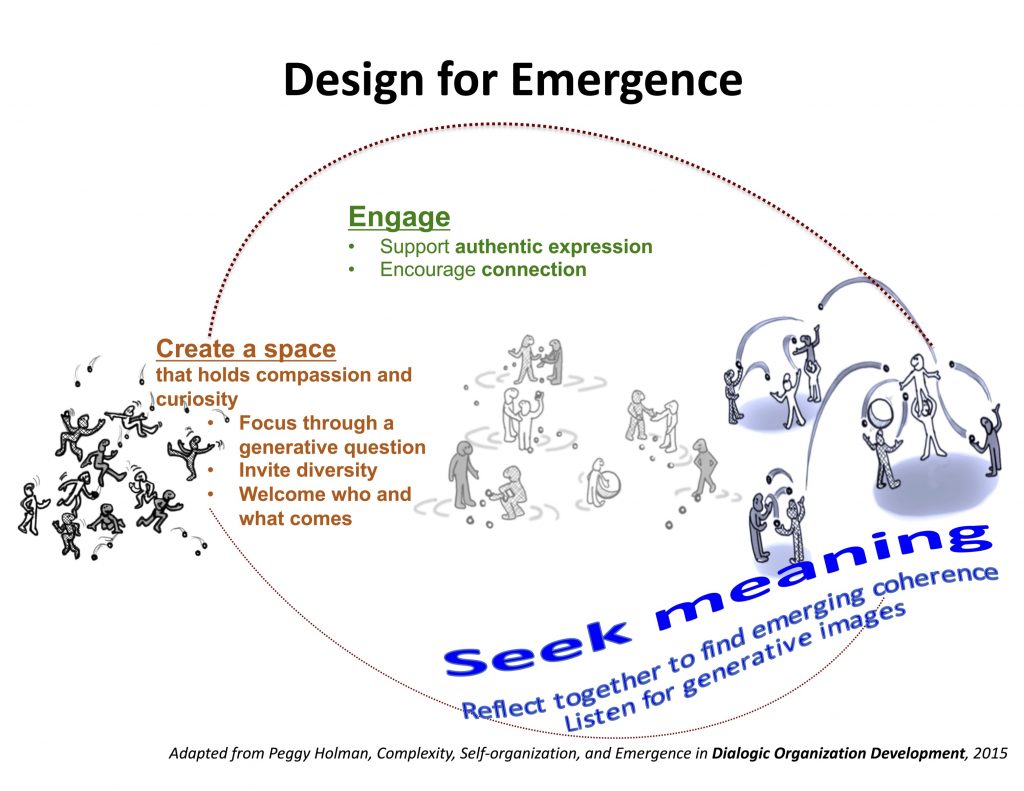
The practices for engaging emergencepreparing oneself, hosting others, stepping up and stepping in, and doing it again – equip us to get involved and influence others.  The more internalized the principles of welcoming disturbance, seeking meaning, pioneering, encouraging random encounters, and simplifying, the more promising the outcomes.

Civil discourse is a pathway to addressing complex challenges because we need each other to find answers none of us can discover on our own. Creativity lives on the edges where unexpected connections occur.  If we want a vibrant economy that provides good jobs, a healthy environment, excellent schools, and strong relationships with neighbors across the street and around the world, we need each other.  In fact without each other, it is impossible to create the kind of democracy that, as President Obama said, “is as good as [nine year old] Christina[-Taylor Green] imagined it.”

So what are we waiting for?

Let’s talk.

Share
Posted in Engaging Emergence, Leadership | Tagged , , , | 1 Comment